From memory, I believe these add-on modules came into their own when using the 454A with the (gold old) medTester 5000-C.
Specifically, the REM/ARM module or the combined REM/ARM and Return Fault module (RARF) were used during the medTester CQM (Contact Quality Monitor) Test.
The CQM test measured the resistance needed by the ESU to activate the CQM alarm.
The RARF was also needed for the medTester Return Fault Test.
But, as mentioned in Chapter 5 of the manual you refer to, those two modules were specifically aimed at a particular type of ESU (eg:- Valleylab Force 4B) so may, or may not, be of use when testing other ESU's.
The (nine) "Ohm Test Load" modules may be used in cases where ESU tests call for specific loads.
Do you have the modules? The one you show looks like a RARF.
Thank you for your reply.You mean the medTester 5000C, is it a safety analyzer?
Currently I only have a 454a host and I don't have these modules.
I'm learning to use the 454a analyzer properly,I found that "ACTIV" and "DISPERSIVE" are used for ESU energy analysis and RF current test. Is it correct to only connect these two interfaces?And "POWER GROUND" is generally not used?
![[Linked Image]](https://www.ebme.co.uk/forums/ubbthreads.php/ubb/download/Number/796/filename/3.jpg)
In addition, I don't know the actual use of the "CURRENT LOOP" interface. When I press "AMMETER" on the system interface to enter, it is as shown in the figure below
![[Linked Image]](https://www.ebme.co.uk/forums/ubbthreads.php/ubb/download/Number/797/filename/2.jpg)
And after pressing "AUXILIARY" to access, I saw the following prompt on the screen
![[Linked Image]](https://www.ebme.co.uk/forums/ubbthreads.php/ubb/download/Number/798/filename/1.jpg)
I don't know if these are normal or if there is an error
Thank you for your reply.You mean the medTester 5000C, is it a safety analyzer?
Or the DNI Nevada 5000B (see page 3-30 of the manual).
The medTester 5000 is (or at least,
was) a very handy piece of test equipment. At its core it permitted measurement of currents and resistances as they related to electrical safety. It allowed repetitive tasks to be automated using "autosequences" which could be customised. It could act as a portable data acquisition unit controlled by computer. With the right accessories (and a bit of imagination), it could almost "do everything" when it came to testing electromedical equipment - especially if you also had our old friend the Timeter RT-200.
In short, I would recommend that you add a medTester to your collection of antique biomed test equipment!
I should imagine that the Power Ground expects a jack plug - lead - croc clip to the ESU EUT (Equipment Under Test) chassis.
Yes; there is an error ... there are no modules in place!
You mean, if I'm doing ESU automated electrical safety testing, an ESU host,Also need a 454a analyzer, plus a module suitable for the 454a analyzer, and a Nevada 5000B (or 5000c) electrical safety analyzer, all of the above, to conduct ESU electrical safety automatic testing?
454A Auxiliary Test module (REM/ARM&Return Fault monitor, REM/ARM)--these two types are suitable for electrical safety testing?
454A Auxiliary Test Load module (10, 25, 35, 50, 75, 125, 330, 2000, 5000)--these 9 types are for supplementing the built-in resistance value? "Because the built-in resistance is from 50-1550, stepping by 50, it is impossible to have the special resistance values of 10, 25, 35, 75..."
I don't know if my understanding is correct, if not, I hope you can tell me
Short answers (I may add more later if I have time):-
1) No. Use a safety tester - automated or otherwise - for electrical safety testing (EST). But yes, the medTester* does EST (and much more).
2) No. Those modules are nothing to do with EST.
3) Yes and No. Use whatever loads - internal and/or external (modules) - are required. Individual ESU service manuals usually (or at least
should) make clear which loads are required during testing.
In times gone by, some ESU service manuals may have made specific reference to the 454A, and which loads
etc. should be used (some may even have also mentioned the medTester). Manuals usually also lay down step-by-step techniques (or checklists) for testing. Some are better than others in this regard, but I recall that it was hard to lay down
generic testing procedures for ESU's. That is to say:- some had specific requirements. That did not matter too much when considering an individual setting (where only one type of ESU was being supported), but could be "fun" when many different ESU's were being looked after in different locations.
Lastly, you might enjoy
this YouTube video if you have a half-hour to spare (it includes the 454A towards the end - where it is referred to as "old school")!
* If I have whetted your appetite for the medTester ... be aware that they only operate on 115 V (or, put it this way, sadly I have never come across a 220 V version).
Do you mean these 2 modules {454A Auxiliary Test Load module (REM/ARM&Return Fault monitor, REM/ARM)}Only used to test REM/ARM or Return Fault monitor function, not related to automatic test?
In other words, the above two modules can also be used in manual mode, is that what it means?
454A auxiliary test load modules (10, 25, 35, 50, 75, 125, 330, 2000, 5000) - these 9 types are only external loads.They are the same as the internal load, just the resistor values are different, I understanding this correctly?
I believe that both modules may be used either manually or in auto modes ("autosequences" etc.). See Chapter 5 of the manual.
Yes, the 454A has internal test loads from 50-1550 ohms. The (optional) add-on test load modules may be needed when testing special purpose ESUs. For example:- 25 ohms (eg, for thermal ablation) and 2000 ohms (eg, for orthopaedic surgery). Otherwise you shouldn't need them.
Notes:-
ARM: Aspen (later Automatic) Return Monitor
CQM: Contact Quality Monitor
REM: Return Electrode Monitor
Return Fault Monitor: continuously compares the difference between active and dispersive currents.
Note that in the YouTube video referenced earlier the guy used a resistance decade box to check the REM trip resistance. I'm guessing that's more or less what the REM/ARM modules do.
I don't know the actual use of the "CURRENT LOOP" interface.
All I can say is that you refer to page 3-9 of the manual. But note well that, if experimenting with applying "external load configurations" you need to heed the warning about the requirement for a load resistance of "adequate power rating".
Lastly, don't forget two aspects that often get overlooked:-
1) The oscilloscope output. I always liked to check-out the various waveforms.
2) "Crest factor" (CF) - both 454A and QA-ES display these values.
Basically, CF= Peak Volts/RMS Volts. It is desirable to have a high CF when Coagulating tissue and a low CF when Cutting tissue. CF is an indication of how well an ESU output can Coagulate without Cutting. Typical values are around 1.4 for pure sine wave to about 10 for Coag.
Crest Factor is defined as a ESU's ability to Coagulate without Cutting. The ideal is to slowly shrink the top layer of tissue whereby the capillaries seal off bleeding without causing any further penetration or tissue necrosis. In order to achieve this ideal, the CF for Coag must be as high as possible - typically rated as a multiple of RMS (
eg, CF of 7 to 10). If CF is high enough, the power under load will ideally drop to zero before cutting. This is also proof of a High Impedance source.
By the way, I've never used a 454A myself. The best I ever had to make do with was the Bio-Tek RF-302 (and before that, various "home made" options of the "needs must" variety).
I check that the "CURRENT LOOP" leads go inside the 454a host,Looks like a current transformer principle,And it can only test AC current, DC current does not work.
Of course the ESU current has always been of the high frequency AC type.
I have QA-ES -II and DNI/FLUKE 454a,I found that the display effect of 454a is the best, the actual visual experience of QE-ES II is not very good, because the displayed number is very small.Observe the power value or current value, need to look very carefully。
454a only responds to AC signals, QA-ES II responds to either AC or DC,Of course ESU has always been an AC signal.
So 454a is more like the principle of induction measurement, and QA-ES II is more like the principle of attenuator measurement---This is my actual feeling, may be wrong
Good pictures of the module (a nice find). That 15 pin D-shell connector looks a bit vulnerable (especially after some years of use). Obviously the Active (yellow), Dispersive (blue) and Ground (green) sockets pass through to mate with the main unit below (supposedly measuring active and dispersive currents for comparison along the way). So it looks like you could still carry out ESU output checks as usual. However (and as made clear in a warning label on the module) you should not operate the ESU when the Patient Return Inputs (red sockets) are connected as a substitute for the ESU dispersive (return or "plate") electrode.
You will have already noticed that any of the modules hide the CURRENT LOOP sockets of the main unit. I have been wondering about what is behind those sockets. It would be nice to see the 454A circuit diagram(s). However, after 0:37 in
this video you can see the guy making use of the CURRENT LOOP sockets.
I agree with your comments about the 454A
- versus - the QA-ES. Although it has (had) "old technology" (early 1990's) I would say that the 454A is the more useful of the two ... at least to the "deployed" biomed. The QA-ES is far too bulky to lug about; OK as a workshop based piece of test kit, maybe.
You're spot on about the displays too. Nice big digits for the Watts reading on the 454A. Meanwhile the display on the QA-ES has hardly evolved from the original Metron version (early 2000's) ... in fact I prefer the original one (nice colour scheme, at least).
By the way, it seems that the latest Fluke catalogue only lists the QA-ES III under Electrosurgical Analyzers ... so it looks like not only the 454A but also the RF-303 have been discontinued (since around 2007 or so in the case of the 454A). However, BC Group (BC Biomedical) used to market what looked like an improved "454A" as the ESU-2300 (it has all the features, without the need for modules) ... complete with USB-B comm connector (wow)! Not sure if that one (c. 2012) is still available. According to the manual, it uses an RF current transformer to convert the high frequency RF signal from the ESU to a voltage signal.
Lastly, I'm sure you will find
this presentation interesting. For instance, the "What are we measuring?" graphic(s) on page 4.
... better make that page 13.
I am lucky enough to have both a QA-ES ii and a 454a analyzer。
From
https://www.slideshare.net/merwine/5th-generation-esu-technology-june-2009this documentation I found many errors,For example, QA-ES ii does not use capacitors, but uses impedance matching technology.The documentation says it's a capacitor.And the analysis is not objective. It has been emphasized that the technology of BC GROUP is very advanced.In addition, the QA-ES II uses a resistor with 0 inductance, and there is no inductance at high frequencies.
This doc looks more like a salesman's marketing gimmick ^_^
QA-ES II uses impedance matching technology, using AD834 multiplier
454a uses the principle of current sensing, using the LT1088 thermal conversion principle, so QA-ESII responds to DC signals, and 454a only responds to AC signals
Fluke's latest QA-ES III analyzer, I don't think it is a revolutionary innovation, the selected solution may also be AD834 or a similar chip, maybe a higher precision resistor is selected for the load resistor, but I think this has no practical value , the only bright spot is that QA-ESIII has increased the frequency display function, but this is actually not important
But some external load modules have (CURRENT LOOP) (25 ohm, 75 ohm) and some don't 125 ohm, I don't know why
I think you may be mistaken (probably looking at the under side of one of the REM/ARM
etc. modules).
According to the conventional theory, an external load (CURRENT LOOP) should be connected, because this is the entrance to obtain the induced current
I can't see that you would want to involve the CURRENT LOOP sockets when using any of the load modules. So much for "conventional theory"!
This doc looks more like a salesman's marketing gimmick
Well, you're right (see page 5 of the document); but to be fair, the author was very experienced in the product development of a good number of ESU analyzers. But yes, he was working for BC Group at the time of the presentation.
However, personally I agree with him ... if "money was no object" I would go for the latest ESU analyzer from BC Group (which is the ESU-2350, I believe).
QA-ES II does not use capacitors, but uses impedance matching technology.
I believe you're right. Well spotted!
https://www.ebay.com/itm/3035985129...338722076&customid=&toolid=10050It's a 125OHM connection, I'm not mistaken, unless the seller is wrong or altered
I mean, 25OHM and 75OHM external resistors have "CURRENT LOOP" connected to the 454a host, but 125OHM does not.0:37 of
https://www.youtube.com/watch?v=zYdwkvXRL-0this video,The "CURRENT LOOP" interface should be dedicated to the external resistor, and the current signal of the external resistor may come from here.
The ESU-2350 is really good, but it's too big unless it's been tested in the workshop, which is going to be tough for portable use,And I think BC manufacturers added 'DSP' signal processing, it doesn't matter for actual use.Typically, the actual testing of the ESU is done in one operation room before moving on to the next operation room. Portability is very important.
The power dissipation resistors inside the host take up a lot of volume, it would be revolutionary if only one resistor could meet all the needs。
Looks like an "Electronic Load Tester", I know it's not possible because of the high frequencies, it's just my imagination
That video comes up as "not available".
Meanwhile, for PM etc. (and portable) use, the BC Group ESU-2300 looks good (as mentioned before).
But what's your opinion of the approach (measurement technique)* - no internal loads - used by the ESU-2050? It looks a bit pricey, especially considering all the "accessories" you would need - Pearson current transformer(s), a number of precision resistors, footswitch simulator etc. - plus the CQM-2000 (or similar) for testing REM. But it's lightweight, portable and highly accurate.
* If you believe the reports, it - current transformers etc. - is what the major ESU manufacturers use when calibrating their units. Note (by the way) that the ESU-2300 has a current transformer internal to the unit.
DSP? Or DFA? Apparently, "Digital Fast Acquisition" technology digitizes current transformer output signals using a high-speed analogue to digital converter. DFA technology achieves the high level of accuracy associated with modern ESU's, and effectively replaces the Fluke 8920A Wideband Digital Voltmeter previously used by ESU manufacturers (and some lucky biomeds). By the way, I'm sure I'm not the only one who still wonders why Fluke discontinued - and, as far as I am aware, never replaced - the 8920A.
For “CURRENT LOOPâ€
The video is Dynamics Circuit's video about calibrating 454a,From the video, "CURRENT LOOP" is specially prepared for external resistors.But (
https://www.ebay.com/itm/3035985129...338722076&customid=&toolid=10050) this seller sells 125OHM external load without "CURRENT LOOP" pin.i don't know why.
For ESU-2050
It seems to me that it is just a host, and there is no built-in load resistor.If you want to achieve the same test load resistance value as 454a or QA-ES ii, iii, it will be very bulky.ESU-2050, ESU-2300 they look more like the continuation of 454a, because they all use current transformers
For DSP
Using DSP technology in the ESU analyzer, I think it's more of a gimmick。The use of DSP technology will definitely improve the accuracy of analyzer measurement and the perfection of waveform.For the accuracy, I think it is good to be able to reach 2%-5%, and I think the accuracy of 1% has no practical significance,Because the load resistance is difficult to achieve 1%, even if the temperature change is achieved, the accuracy will be affected,Reliability and portability are more important than accuracy
For Fluke 8920A
8920A is a very good meter,Its 20M bandwidth has not been surpassed so far.(After the discontinuation of production, many ESU manufacturers use RHODE & SCHWARY URE 3 for calibration),Especially for the analysis of Jianfeng waveform, it uses the same heat conversion principle as 454a, I think this is objective and scientific.Maybe the LT1088 discontinuation is the main reason.I also have an 8920a that I've been using and it's been pretty accurate over the years
Most of us can only dream of owning test equipment like the Rohde & Schwarz URE-3 RMS/Peak Voltmeter (up to 30 MHz). But it's already "old" (1990's?), so let's hope they don't discontinue it.
"Jianfeng waveform" ... would that be the work of Jianfeng Weng? I had not come across that notation before.
But
here we go. The bit I liked the best comes at the end:- Fourier's Song!
![[Linked Image]](https://www.ebme.co.uk/forums/ubbthreads.php/ubb/download/Number/813/filename/tms320f.jpg)
DSP technology is very good.I'm not against using DSP.but look here(
https://www.ebme.co.uk/forums/ubbth...000d-7000-are-terrible-testers#Post76806)
Fluke IMPULSE 6000D DEFIB analyzer Used TMS320F2812GHHA,It is a DSP chip.Frequent failures in actual use and difficult to repair
There is also 6000D, which cannot work when the battery is fully charged. You must disconnect the battery and reset it. The battery is installed at the bottom of the motherboard, and it is a Ni-MH battery.
At first, I guessed that my 6000D may have been used for a long time (about 5-7 years),So I bought a 7000, also made by flukebiomedical, but still the same,The new 7000 defibrillation analyzer has only been used for 3 days, and it cannot be turned on when it is fully charged. It is necessary to disassemble the main board, separate the battery from the main board, and it is normal again.
So I think this is an inherent failure of the impulse-6000d-7000 and cannot be repaired。
So sometimes the latest tester from the best known manufacturer isn't the best
But the classic Bio-Tek QED-6, it has been working very stable, only using a 9V battery to work
The old Cardiac Recorders defib tester was even simpler - just a hefty resistor and a neon.
To my mind, a lot of modern test kit (and, indeed, equipment in general) is too "smart" for its own good; often full of unnecessary "features". And (as your example shows) is not necessarily well designed!
Especially during routine PM (on which a lot of in-house biomeds spend a lot - if not most - of their time), all that's needed is a quick and easy "check" that all is well. With a bit of thought (and basic understanding) you can usually come up with a single test (or maybe just one or two) that "prove" the equipment being looked at, without testing every single feature and/or to the "nth degree". If such a test fails, then the kit is removed for more detailed investigation, and a Job Order raised if necessary.
Old guys like me have been lucky enough to "grow up" through the evolution of biomed test kit, and have many favourites from the old days. I always liked Bio-Tek. I always wanted a Lionheart (but had to make do with a little S&W, I think it was). Also Metron - the first to introduce clever stuff like Ansur. But DNI had the best range of test kit (especially when working overseas) - so I must again mention the mighty medTester!
I believe it was a pity that Fluke bought up so many of the smaller (innovative) companies. Of course, BC Group has also consolidated, but - in my opinion - are making a better job of rounding out their range of modern test kit.
I should also mention Datrend, who now have a nice range of biomed test kit. Other names - mainly from the past - include Clinical Dynamics, Dale, Neotech, Timeter, Victoreen et al - and I guess that Pronk is still around. Meanwhile, in the UK, Rigel has always been popular, and (like many others, I suspect) I have fond memories of the 233 Electrical Safety Tester.
Especially if you could justify at least 0.5 hr doing a single safety test (using the 233) of which I had one stolen back in 1989 from the Radiology dept (hidden and under lock and key) here in Rome, most strange as I was the only Biomed........
Well, they were quite an attractive item (also relatively expensive) back in the day. But I always found radiographers to be decent types ... "kindred spirits" (to us), a bit like lab techs. But at least the 70's and 80's were still the era of "wet processing" (that lovely aroma as you entered the department). I'm hoping that, like me, you spent many happy hours immersed (sometimes literally) in the Williamson "Rapid" film processor ("state of the art", at the time).
My then boss wasn't very happy when I got the company to fork out for a 233 as a condition for me returning to Nigeria back in 84/85. He was even more unhappy when most of the kit he had supplied to Lagos, Ibadan, Port Harcourt et al subsequently failed EST. Maybe the humidity was the root of the problem ... but at least it proved that my suspicions had been well founded.
In another life, we bought the "latest gear":- the Bio-Tek 601 Pro (the pre-Fluke, good looking version from the early 1990's). The only trouble there was it rarely got passed booting up due to not finding a decent earth. That was when visiting "desert clinics" and the dreaded (but common) "earth" at the centre tap of the mains transformer situation. From memory, I think the tester needed less than 8 volts between neutral and earth (but often got 110)!
But half an hour per test, Malcolm? Surely not once you got used to it. What did you replace the stolen 233 with, I wonder? Not the 277, I hope.
Meanwhile - and back on topic - have you ever come across the 454A? And (or) any wise words on testing ESU's in geenral?
I was implying "justifying" half an hour not time taken to..... ;-))
and yes the contractor bought the 277 (from the UK in fact which caused all sorts of problems)
Actually the 277 was an interesting piece of kit. Although it must be said that I only got to play with one on a single occasion ... checking it out to see if it was worth shipping (donating) to Africa ... where it is hopefully still being put to good use.
I seem to recall noticing how easy it could be to accidentally switch it off when plugging-in (or un-plugging) the DUT (although that may have been just me being ham-fisted). But you could save results for later downloading to the master PC back at base. Quite advanced stuff at the time.
But did you get to use the "Brain Cell" accessory (scanner, wand ... whatever)? I think it's a pity that didn't catch on (that is, didn't become widely adopted), and that the 277 itself wasn't developed further (to cater for IEC-62353, for example). Hand-held devices (such as the 288) are all very well, but sometimes a more hefty piece of "traditional" test kit may be more appropriate ... not to mention less likely to get "lost"!
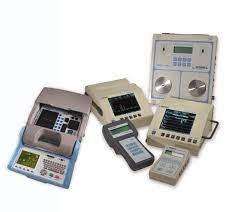
The first image illustrates what I was driving at earlier (post #77146) about manufacturers broadening their range with products originating from "others". Otherwise, note that the 277 appears at the left. The second image shows data from a "Brain Cell" (similar to a modern RFID tag) being scanned into the 277. The third image shows the early Bio-Tek 601 Pro that I alluded to in an earlier post (#77132).


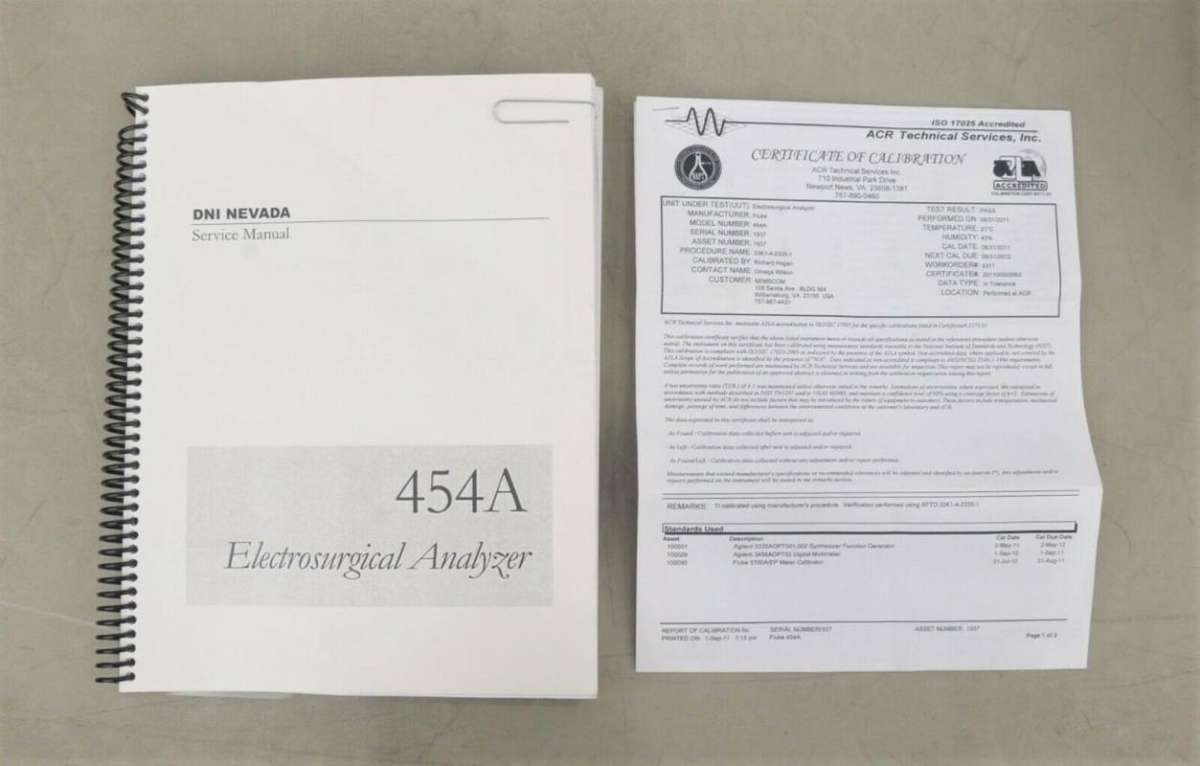
We still need the Service Manual for the Dynatech Nevada (DNI) 454A ESU Analyzer.
Someone out there must have it ... or perhaps be in a position to scan various pages. We are especially interested in how to calibrate the 454A.
I once tried to change the power supply setting of the MEDTESTER 5000 to 220V. The machine can start normally at 220V voltage, but it will report an error: the system voltage is too high, which should be a voltage range limit.
In my impression, 'Current LOOP' is just a wire passing through the current loop, which is equivalent to providing an external path where external loads can be used. This form is equivalent to the connection method of BC Group ESU-2050.
Is your MEDTESTER 5000 still undergoing continuous improvement?Looking forward to more information sharing from you
We still need the Service Manual for the Dynatech Nevada (DNI) 454A ESU Analyzer.
Someone out there must have it ... or perhaps be in a position to scan various pages. We are especially interested in how to calibrate the 454A.
Good news, thanks to the way to enter the calibration mode provided by the poster owner, I have successfully completed the whole calibration process in half a day with the online cooperation of the question owner today. The whole process is very simple. You need to prepare an RMS voltmeter (such as Fluke 8920), an AC signal source (2.8-30mvRMS is required), and a DC voltage source (0.45VDC is required), After entering calibration mode, you only need to follow the screen prompts to do the following work: short circuit the BNC socket on the circuit board (make the AMP input zero), apply 0.45VDC to the TP4 pin on the circuit board, follow the prompts to input the required AC RMS millivolt voltage to the BNC socket on the circuit board in sequence (connect the three terminal BNC plug to FLUKE8920 to monitor the voltage of the BNC socket on the circuit board in real time), and finally complete the entire calibration.
![[Linked Image]](https://www.ebme.co.uk/forums/ubbthreads.php/ubb/download/Number/793/filename/1.jpg)
![[Linked Image]](https://www.ebme.co.uk/forums/ubbthreads.php/ubb/download/Number/794/filename/2.jpg)
![[Linked Image]](https://www.ebme.co.uk/forums/ubbthreads.php/ubb/download/Number/795/filename/3.jpg)
![[Linked Image]](https://www.ebme.co.uk/forums/ubbthreads.php/ubb/download/Number/803/filename/454A option module1.jpg)
![[Linked Image]](https://www.ebme.co.uk/forums/ubbthreads.php/ubb/download/Number/804/filename/454A option module2.jpg)
![[Linked Image]](https://www.ebme.co.uk/forums/ubbthreads.php/ubb/download/Number/805/filename/patient return1.jpg)
![[Linked Image]](https://www.ebme.co.uk/forums/ubbthreads.php/ubb/download/Number/806/filename/patient return2.jpg)
![[Linked Image]](https://www.ebme.co.uk/forums/ubbthreads.php/ubb/download/Number/807/filename/25ohm1.jpg)
![[Linked Image]](https://www.ebme.co.uk/forums/ubbthreads.php/ubb/download/Number/808/filename/25ohm2.jpg)
![[Linked Image]](https://www.ebme.co.uk/forums/ubbthreads.php/ubb/download/Number/809/filename/75ohm1.jpg)
![[Linked Image]](https://www.ebme.co.uk/forums/ubbthreads.php/ubb/download/Number/810/filename/75ohm2.jpg)
![[Linked Image]](https://www.ebme.co.uk/forums/ubbthreads.php/ubb/download/Number/811/filename/125ohm1.jpg)
![[Linked Image]](https://www.ebme.co.uk/forums/ubbthreads.php/ubb/download/Number/812/filename/125ohm2.jpg)