

If you have any departmental or Trust news you'd like to share, please get in touch.
- Details


Euro Energy are proud to announce that we will once again be attending the EBME Innovations Seminar.
This fantastic event brings together all healthcare engineering professionals, be they medical equipment manufacturers, suppliers or end users. Once again, Euro Energy will be exhibiting at the seminar with a sample of our comprehensive product range of medical batteries and accessories. 2017’s event was a great success and we are very pleased to be heading to the Milton Keynes Double Tree Hilton Hotel on 26th April 2018 for the 2018 Seminar.
So, make sure to book your place and come and visit us on stand A23 to view our display of batteries and accessories, and discuss your needs with our sales team.
For more information on Euro Energy being at the EBME Seminar 2018, just call us on 0116 0234 0567 or email This email address is being protected from spambots. You need JavaScript enabled to view it.
- Details

EBME Seminar : 26th April 2018
Venue : DoubleTree by Hilton Hotel, Milton Keynes. (Home of the MK Dons)
The EBME seminar now in its 9th year, continues to grow both in delegate attendance and reputation. The seminar is a sponsored event, but independent of any one commercial company. The EBME Medical Innovations seminar brings together healthcare professionals responsible for the management of medical equipment and involved in areas such as procurement, maintenance, user training, and managing inventories.
The event will be a mixture of presentations and debate and will cover productivity, modernisation, quality - with the audience participating in a debate with our expert speakers. The aim of the event is to share knowledge and improve awareness, thereby raising the profile of our profession.
Thanks to the sponsorship of our exhibitors, this seminar is offered Free of Charge to our delegates*, and includes:

 Independent exhibition (45+ stands)
Refreshments throughout the day
Hot lunch
Each attending delegate will receive a certificate for their CPD record.
Free entrance into the prize draw
*Staff from the Military, Students & Staff working in operational roles in private or public hospitals may all attend FOC.
Company representatives' from private companies may be charged for attending the event.
Continuing Professional Development
 Each attending delegate will receive a certificate for their continuing professional development (CPD) record.
This educational seminar meets CPD requirements for the NHS knowledge and skills framework (KSF): 'Core dimensions 2, 4 & 5; and specific dimensions IK1, IK2 & IK3'.
Central Location
Situated in Milton Keynes, within easy access of the M1 and Milton Keynes Train station, Double Tree Hilton is an impressive venue integrated into the West stand of the new 22,000 seat stadium - home of the MK Dons.
 For more details including exhibitors, maps, topics for discussion and how to register - please visit the EBME seminar website.

Prize Draw :
Don't forget...
Every delegate attending will be eligible for our prize draw give-away.
(Previous years prizes shown above.)
- Details

 The EBME Seminar is an educational event with the exciting theme of ‘the latest innovations in healthcare technology’. It brings together the healthcare engineering community with medical equipment manufacturers and suppliers. The role of the seminar is to promote sharing of knowledge, to improve the use of medical technology, and to allow sponsors to exhibit during the seminar; enabling them to meet their customers.
The Seminar and exhibition is once again taking place at the Doubletree by Hilton Hotel in Milton Keynes; home of the MK Dons. This venue offers the largest exhibition space in the area, accommodating all of the exhibitors in one spacious hall which is situated immediately adjacent to the seminar hall.
This is a sponsored event, independent of any one commercial supplier, with exhibition spaces being sold on a ‘first come, first served’ basis.
Bookings can only be made through the online system which opens to the general public on Monday 13th November 2017.
Exhibitor registration: http://www.ebmeseminar.com/exhibitor-registration.
Companies that have sponsored (or advertised on) the www.ebme.co.uk website in 2017 will have earlier access to the bookings system, and will be notified of their priority dates.
Potential exhibitors can find general information about the seminar at; www.ebme.co.uk/seminar and more exhibitor information at: http://www.ebme.co.uk/ebme-seminar-info, where you can also submit your contact information at the bottom of the page if you would like to be sent further information.
- Details

Supplying medical devices with the highest possible security standard
Hemel Hempstead – Dräger, an international leader in the field of medical technology, offers customers peace of mind through comprehensive consideration of cyber security at every stage of the product development lifecycle. This ensures its devices meet the highest standards, and as such, Dräger has received the DIACAP and FIPS accreditation from the US Department of Defense. In addition, Dräger has set up its own cyber security website.
"Technology for life must be reliable. For us, this means thinking of a safe design at an early stage in the development of new products." confirmed Hannes Molsen, who is responsible for the security of all products at Dräger. This means, for example, simulating and ruling out potential security gaps right from the outset when developing software. Other requirements include; supplying medical devices with the highest possible security standard, protecting them against unauthorised access and "hardening" their operating systems. "By omitting unnecessary software components, we can limit points of attack from the outset," stated Molsen. In order to safely operate devices over their entire lifecycle, they must be developed in such a way that they can receive security updates at a later date.

"There is no way to guarantee that a system is 100% free of vulnerabilities, however, there are ways to reach a high level of security," emphasises Molsen. This is supported, for example, by communicating with external developers and IT users. This not only applies to conferences and hospital visits, but also via the Dräger website.
In response Dräger has now launched its own cyber security section www.draeger.com/cybersecurity where customers, developers, and security researchers can find out more information on how Dräger considers cyber security in product devleopment, view the certifications and accreditations awarded, and also directly report any potential weak points or possible risks that they have observed in connection with the security of Dräger products.
Dräger. Technology for Life®
Dräger is an international leader in the fields of medical and safety technology. Our products protect, support and save lives. Founded in 1889, Dräger generated revenues of more than € 2.5 billion in 2016. The Dräger Group is currently present in over 190 countries and has more than 13,000 employees worldwide. Please visit www.draeger.com for more information.
- Details

 Pentland Medical, the UK distributor of the Nasal Alar SpO2 Sensor (Xhale Assurance Inc, Fl. USA), is pleased to announce that the National Institute for Health and Care Excellence (NICE),1 has issued a Medtech Innovation Briefing (MIB) on the Nasal Alar SpO2 Sensor (Xhale Assurance Inc, Fl. USA), currently the only sensor designed to detect peripheral oxygen saturation (SpO2) at the nasal ala. The Nasal Alar SpO2 sensor is currently being used in 15 NHS hospitals.1 This innovative, disposable, single patient use pulse oximetry sensor is specifically designed to improve sensor accuracy and reliability in those with poor peripheral perfusion. The combination of light-emitting diodes and the photodiode pulse oximetry sensor in the plastic nasal clip use photoplethysmography signals to determine the SpO2 levels in the blood vessels of the nasal ala, a highly vascular region that is fed anatomically by both the external and internal carotid arteries. This multi-directional arterial supply provides strong, reliable photoplethysmography signals that respond rapidly to changes in the patient’s arterial oxygen saturation.
The nasal alar site has other advantages:
• It has no clinically significant sympathetic tone, so does not lose signal due to the patient being cold
• It is less affected when patients experience diminished peripheral perfusion, such as cardiovascular disease, hypovolaemia, or from medications that cause vascular changes
• It is less subject to signal distortion due to sensor interference from ambient light
• The strong signal from this location provides consistent accuracy, even at very low oxygen saturations
• It makes the sensor less likely to be dislodged, which reduces alarms
• It is easily accessed by an anaesthetist during surgery; non-adhesive attachment makes the sensors easy to reposition
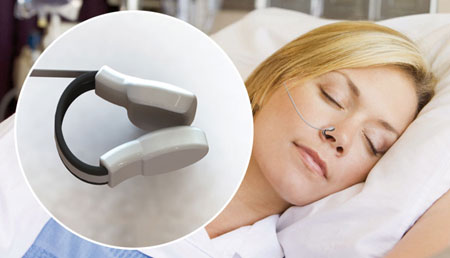 The sensor is simple to use; the non-adhesive sensor clip is designed to be better tolerated and more comfortable for patients than other sensors, especially in those who are susceptible to skin breakdown, at risk of pressure ulcers or have sensitivity to adhesives.1 It has a cable with a connector that is compatible with most pulse oximetry monitors. The Nasal Alar SpO2 sensor can be used in any healthcare setting where continuous SpO2 monitoring by pulse oximetry is required such as emergency wards, intensive care units, operating theatres and ambulances.1 It is indicated for use in adults and children (weighing more than 30 kg) for the continuous non-invasive monitoring of peripheral oxygen saturation (SpO2) and pulse rate.
It is contraindicated for patients weighing less than 30 kg, on sites with compromised tissue or non-intact skin, and for any patient with a medical condition that decreases nasal alar blood perfusion or that increases nasal alar venous congestion or swelling.1
The cost of the Nasal Alar SpO2 sensor is £20.62 per unit (exclusive of VAT), or £495 per box 24 (exclusive of VAT).
Pentland Medical Ltd.
48 Craighall Road
Edinburgh
EH6 4RU
Email: This email address is being protected from spambots. You need JavaScript enabled to view it.
Phone: 0131 467 5764
Fax: 0131 476 1574
www.pentlandmedical.co.uk
References
1. National Institute for Health and Care Excellence. Nasal Alar SpO2 sensor for monitoring oxygen saturation by pulse oximetry. Medtech innovation briefing [MIB113]. NICE. July 2017. https://www.nice.org.uk/advice/mib113
