

If you have any departmental or Trust news you'd like to share, please get in touch.
- Details

Caring staff at Derby Teaching Hospitals NHS Foundation Trust, currently featuring in a new ITV hospital documentary 'Superhospital' have been demonstrating their star qualities to an audience of millions.
One of those qualities - a willingness to look at new ways of doing things - has been amply demonstrated in the Trust's recent decision to switch all 2,000 of its blood pressure monitoring devices over to Welch Allyn's unique FlexiPort blood pressure cuff system.
The result has not only saved the Trust money, most importantly, it has released nursing time back to caring for patients.
Before the changeover, blood pressure monitoring had been taking far longer than it should. Over the years, the Trust had built up a range of BP machines, each requiring dedicated cuffs and connectors.
As a result, nursing staff could lose precious minutes trying to find the right match. Some machines were under-used as a result; some not at all. Boxes of spare cuffs, some incorrectly ordered, built up on the wards.
Stephanie McCarthy, Clinical Procurement Nurse at Derby Teaching Hospitals had already led efforts to successfully standardise other core products such as gloves.
 Blood pressure cuffs were an obvious candidate for a similar process - but only if worthwhile efficiencies, clinical benefits and cost savings could be achieved. 'We needed a generic system to fit every blood pressure machine - but it had to achieve savings of at least seven per cent,' she explains.
While there are many cuffs on the market, the unique features offered by the Welch Allyn FlexiPort system combined to make it the must-buy choice.
Easy to fit, use and remove, FlexiPort cuffs have a one-handed snap on, snap off connection and can be attached to patients in seconds - quicker and simpler than any other system.
A simple conversion in minutes is all it takes for FlexiPort cuffs to work with any blood pressure device, regardless of make or model.
Patient comfort is significantly improved with the rotatable port, which stops tubing causing patient discomfort, and can be swiftly moved aside during surgery while the cuff remains in position, making access far easier for theatre staff.
With one of the widest range of sizes available on the market, including five for adults, the Welch Allyn cuffs prioritise BP accuracy. In addition to reusable cuffs, there are also disposable equivalents, and a single-patient use version, particularly suitable for barriered patients.
The decision to go with Welch Allyn was made at the end of 2014. Following a successful trial in the MAU (Medical Assessment Unit) - one of the busiest wards in the hospital - the hospital-wide conversion, was rolled out over an eight-week period in April and May this year.
More than 2,000 blood pressure devices across the hospital were equipped with the FlexiPort fitting and Welch Allyn FlexiPort cuffs.
Comprehensive support offered by Welch Allyn covered everything from preparing internal staff communications, to a physical presence on the wards during implementation, with Welch Allyn personnel working alongside Derby Teaching Hospital's technicians to ensure that the process was problem-free.
Conversion of the MAU's ten blood pressure devices averaged just a minute apiece - around 25 per cent faster than anticipated - and the process went so smoothly that staff were barely aware it had happened. 'I came to work one day and they were just in,' says MAU Sister Rebecca Pipes.
A month on, the changeover has been voted a complete success. Cuff and machine mismatches, stock shortages and incorrect ordering have been reduced to virtually zero.
Spending on cuffs is anticipated to reduce by 75% which equates to half a staff nurse's salary every year, well ahead of the Trust's seven per cent target.
Even better, 100 per cent of staff surveyed agree that their working lives are easier, enabling them to spend more time with their patients.
The long-term goal, says Stephanie McCarthy, is greater use of single patient use cuffs. 'Cuffs that could follow the patient all the way through is the golden aspiration.'
For now, however, there's universal praise for the way the Welch Allyn system has improved daily life for staff and patients. Their advice to other Trusts thinking of doing the same thing? 'Be brave and go for it.'
'We pride ourselves on providing a complete partnership to our customers,' says Jan McMeekin, Regional Sales Director at Welch Allyn UK Ltd. 'Successful standardisation is about far more than just the product. It's also about providing the 360 degree support that goes with it. Our work with Derby Teaching Hospitals shows just how effective this collaborative approach can be.'
- Details
Welch Allyn has launched its third generation Connex® Spot Monitor (CSM) which marks a major advance in enhancing patient safety through technology.
 With a continuing focus on paper-light routine observations and EWS (early warning scores) in the NHS, the new Welch Allyn CSM is well positioned to become the device of choice for cost conscious, yet quality-driven hospitals, offering industry-leading technology to help liberate UK hospital staff from the time-consuming and sometimes error-ridden systems of the past.
Providing comprehensive and accurate patient documentation in a single device, the CSM has been developed with substantial input from clinicians and builds on Welch Allyn's expertise in vital signs monitoring (VSM) through the world-leading Connex range.
Customers can expect best-in-class vital sign technology in the CSM, such as 15 second blood pressure readings with SureBP®, while Nonin's impressive results in clinical trials makes them an attractive addition to pulse oximetry options, also provided by Masimo® and Covidien®, with fast, accurate thermometry from either Braun Thermoscan Ear or SureTemp® Plus technology.
In addition to automated measurements, up to 20 additional non-automated parameters such as levels of consciousness and pain can be entered into the CSM manually, creating a central point of data entry for all patient observations. This data can then be easily transmitted wirelessly to an electronic medical record system (EMR) if desired.
Customisable to each hospital's needs, every part of the CSM has been developed with patients and users in mind, from the easy to use touchscreen controls to the uniquely quiet WhisperDrive™ wheels on the roll stand.
Key clinical points:
- Early warning scores - fully customise and switch between three scores like EWS, MEWS or PEWS
- Three modes: Spot check, Intervals and Office
- Supports adult, paediatric and neonatal patients
- BHS A/A validated SureBP® technology - take a BP in 15 seconds
- Choice of leading SpO2 technologies: Masimo®, Nellcor® or Nonin®
- Optional thermometry - Braun Thermoscan Ear or SureTemp Plus
- A central point of data entry for up to 20 manual patient observations
- New blood pressure averaging (to help mitigate the effect of white coat hypertension).
Key technical points:
- Available wireless ready or upgrade later
- Easy to use vivid touchscreen display
- Made with materials highly resistant to cleaning agents
- Proven integration with more than 90 leading EMRs including Epic, Meditech and Cerner
- Upgradeable design to help protect investment
- Up to 17 hours of operation with the optional power management stand
- Configuration tool - centrally control how all devices behave
- Customise devices at time of purchase - ready to go out of the box
With documentation error rates using paper observation charts as high as 54.4 per cent1 the CSM can help to drastically reduce inaccuracies on patient charts - improving safety and clinical outcomes.
 Using the CSM enables hospitals to fully customise any early warning scoring system and switch between scoring protocols like EWS, MEWS or PEWS easily. Representing a further example of Welch Allyn's commitment to offering maximum flexibility and cost effective operation to customers, it enables trusts which use modified early warning scores to decide which parameters should be scored, what the clinical boundaries for each parameter are, and even set 'required action' messages for the caregiver.
At the touch of the button, all this data can be interfaced with the electronic medical record system, eliminating paper charting altogether if desired, which is why Welch Allyn's proven connectivity solution has already put the Connex range of vital signs devices at the heart of many successful Nursing Technology Fund applications.
The CSM's potential for almost total customisation is designed to help engineers and specialist staff benefit from reduced installation and maintenance time. CSM customisation data can be created using an online configurator, then transferred to the device via USB. Configurations can even be cloned from one device to another.
There is also the potential for units to be fully customised at the point of manufacture so that they are ready to use straight from the box, particularly useful for large sites which require tens or even hundreds of CSMs.
It all adds up to a device which is designed to improve the lives of clinical and non-clinical users alike, improving accuracy and reliability as well as reducing unnecessary admin and maintenance burden.
As Jan McMeekin, Regional Sales Director at Welch Allyn UK Ltd points out, the enthusiastic response from customers is ample demonstration that the CSM is, literally, hitting the spot.
'Our aim with the CSM was simple - to create an affordable device which helps to makes our customers' lives easier, provides unrivalled flexibility and helps enhance patient safety.
'We're delighted to have secured large-scale orders for our Connex products. We strive to give hospitals precisely what they need - trusted, proven technology in a user-friendly format that can be easily adapted to work with any hospital's workflow.'
Numerous studies have found a link between the quality of communications between health care professionals and good patient care, she says. 'We're confident that the new Connex Spot Monitor has a vital part to play in this process.'
1. Early warning system determination accuracy and action plan compliance, 2012, Barts Health Munro, PA & Padala, A.
- Details
On Tuesday 12th May 2015 GE Healthcare officially opened their new Academy and Repair Centre in Hatfield, Hertfordshire.
Following the decision to relocate the Hatfield warehouse, the 12,000 square foot building has been transformed to a new facility in just 10 weeks. The Training Academy has three Healthcare purpose-built classrooms with medical gas and exciting multi-media to deliver excellent customer training and support to both clinical and biomedical customers.
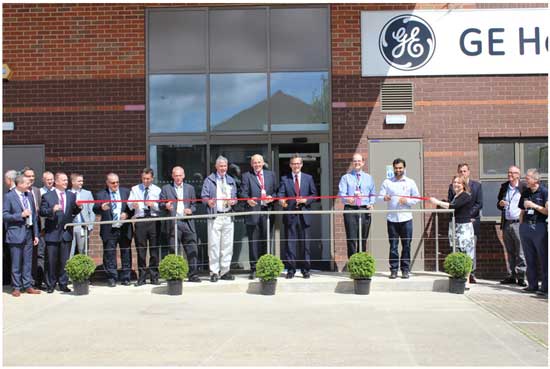 The UK and Ireland Repair Centre has benefited from a regeneration, with 20% expansion incorporated and a capacity to expand further as required, giving a faster time to repair and the ability to support third party servicing. GE Healthcare understands that it is not purely about selling products, but also looking after the products for their useful life. This facility aims to maximise users uptime and provide a swift solution to support customers. Our Repair Centre consists of a team of experienced engineers, some with up to 20 years service, all of whom have helped to secure the exceptional reputation of this facility allowing GE Healthcare to work in partnership with our customers.
Howard Wilkinson, Northern Europe Services General Manager said “We are proud of our new facility and all that it encompasses, GE believe in making new, and innovative products but ultimately, we are here to partner with you and support you in every area; from Anaesthesia and Patient Monitoring, to Ultrasound and Cardiology. We understand that things break, and they need servicing, and this is where we are committed.
 Our journey started a couple of years ago, where we brought you ‘One Services’ and the option of ‘One Self’, an offering where we give you flexibility, with the aim to help when you are busy with high volumes- to deliver training and support, making you more efficient and improve patient care.”
The opening of this facility combined with the continual development of solutions such as the webshop and our investment in companies such as UNISYN probe repair solution are the results of our commitment to provide support to biomeds for now and the future.
GE Healthcare would like to extend their thanks to all the customers who attended the official opening, some of whom travelled many miles. We look forward to welcoming you in the near future to our new facility.
For further information, please contact us at 01707 263570.
- Details
Biomed test instrumentation specialist, Rigel Medical, has produced a free guide covering the electrical safety testing requirements of the IEC 62353 international test standard.

‘An introduction to electrical safety testing in accordance with IEC 62353’ provides an insightful overview on electrical safety, the definitions of a medical electronic device, the IEC 606001 standard and a summary of the IEC 62353 publication including the 2014 additions.
One of the most significant additions to the 2014 edition is the recommendation to test to IEC 62353 at the final production line stage and before equipment goes into service. This will allow recurrent testing to be directly comparable with factory tests, providing easier observation of any variations.
New for the IEC 62353:2014 edition were a number of suggested tests to help manufacturers identify any requirements for isolating a particular equipment leakage current. Advice about this issue is covered in the guide.
Also included is a section on the benefits of the latest range of battery powered electrical safety analysers, which provide a fast and accurate solution for compliance with international and local safety standards. Visit www.rigelmedical.com/IEC62353 to download the guide.
- Details
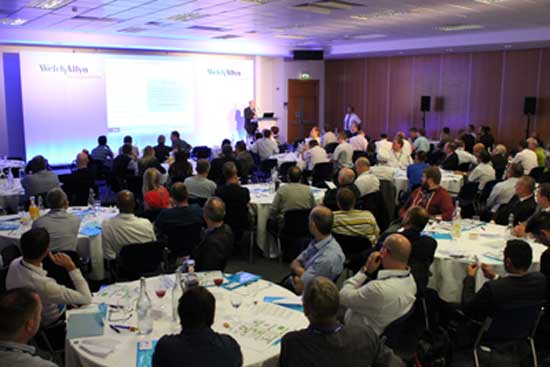 Details of 'Completing the Picture' 2015, the must-attend annual educational symposium for biomedical engineering and clinical procurement specialists in the UK have been announced by Welch Allyn.
The extremely popular event, will take place on Wednesday 17th June 2015 at The Oxford Belfry Hotel, near Oxford.
Designed to improve knowledge and awareness of current and future clinical issues that impact on the industry, 'Completing the Picture' is free to attend and sponsored by an educational grant from Welch Allyn.
The varied programme will cover a range of topics from a number of highly respected speakers. This includes device management guidance from the MHRA, best practice for managing devices in the community, Early Warning Scores and a clinical session about mechanical ventilation, delivered by Dr Carl Waldmann.
Tal Golesworthy, will also give an inspiring presentation about how he mixed his engineering skills with his doctors' medical knowledge to design a better repair job for his own heart.
Supporting the event is incredibly important for Welch Allyn, which has been associated with innovative, ground-breaking medical devices for exactly 100 years.
'Our customers tell us how important this event is to their community, helping them develop a 360 perspective' says Jan McMeekin, Welch Allyn Regional Director.
'As technological advances continue, this event becomes increasingly important. Our commitment to 'Completing the Picture,' is a reflection of this, which is why it is in its 15th year.'
 Event details:
Date:Wednesday 17th June 2015
Venue:
The Oxford Belfry Hotel
Milton Common, Thame
Oxfordshire
OX9 2JW
To reserve a place or request additional information:
Visit: www.completingthepicture.com
Email: This email address is being protected from spambots. You need JavaScript enabled to view it.
Tel: 01296 689900
