

If you have any departmental or Trust news you'd like to share, please get in touch.
- Details


Clinical engineers looking at how hospitals can use technology efficiently to tackle patient backlogs are invited to take part in an interactive workshop hosted by Mindray UK at the next Northern Region Medical Device Management Group (NRMDMG) meeting on 19th October 2023.
The group is a grass roots movement of like-minded clinical engineers who want to share best practice and collaborate with clinical leaders. With support from peers, members can ensure that healthcare providers across the public and private sectors adopt and implement new technologies effectively.
The session will focus on the current bed and capacity challenges within secondary care, specifically the move to virtual wards in primary care to alleviate these pressures and how technology can be used as an enabler whilst also helping to manage the clinical risk.
The workshop is designed to equip teams with the building blocks to integrate devices and optimise data flows so clinical teams can work with confidence. It will cover:
- Virtual Wards and wearable technologies
- Integration and connectivity of primary to secondary care systems
- Secondary care patient EWS dashboards and data management
- Device integration and auto charting systems to:
- Device Manager enabling Medical Device traceability and uptime data.
- Total Hospital Solution.
- Reduce clinical transcription errors
- Releasing clinical time for increased patient contact.
- Real time charting data.
In addition to Mindray’s workshop, there will also be expert presentations from NRMDMG members:
- Benchmarking - Joe Emmerson, Technical Manager, Manchester University Foundation Trust
- Lessons learned through Covid - Stuart Eccles, Head of Clinical Engineering, Countess of Chester Hospital NHS Foundation Trust
- Planning to Reality: Retirement Experiences - Dave Guymer, Former Head of Medical Device Management Services, Sheffield Teaching Hospitals NHS Foundation Trust
The NRMDMG meeting is taking place on 19th October 2023, 9.30am - 5.00pm at the Holiday Inn Brigg House, HD6 4HW.
The meeting is exclusively for Clinical Engineering Managers, and Senior Technicians. It is free of charge to attend. To register, please email: This email address is being protected from spambots. You need JavaScript enabled to view it. at Midlands Partnership University NHS Foundation Trust or visit: bit.ly/3RztN3W
- Details

Are you looking for an established training provider to contribute to improving your workforce knowledge, skills, and behaviours? Here is why you should consider training at Eastwood Park.
The days when you could find an abundance of skilled clinical/medical engineers, is sadly over, presenting a ‘deep and enduring’ severe skills shortage as highlighted recently in a report published by the Institute of Physics and Engineering in Medicine, (IPEM, 2022). The Further/Higher Education, (FE/HE), sector provide ‘T’ Levels, apprenticeships, degrees, and the academic grounding, but at Eastwood Park it has emerged that there is often a gap between FE/HE delivery and the practical and specialist knowledge required as a clinical/medical engineer. This is where Eastwood Park and our modern training facilities seek to close that gap.
The innovative training facility at Eastwood Park provides that safe, effective, modern, and realistic learning environment where clinical/medical engineers can develop their knowledge, skills, and behaviour’s. This is achieved through promotion of learner engagement at an individual level with a wide range of current test equipment, medical devices and supported by sessions in anatomy & physiology, technical techniques, digital skills, and critical thinking. This facilitates our learners to develop confidence, professionalism, and capability to engage with clinicians, IT professionals and analysists regarding the engineering support delivered throughout the life cycle of medical devices. The training delivered by Eastwood Park stretches and challenges our learners placing them at the centre of everything we do within the medical engineering portfolio.
For further information visit: https://www.eastwoodparktraining.co.uk/
Photograph Captions:
-
Mark Fordham, our Medical Engineering Portfolio Manager speaking at this year’s EBME Expo in Coventry

-
Students working individually during a recent Servicing of Ventilation & Anesthetic Equipment Course in our modern workshop

-
Testing of a patient monitor using state of the art test equipment

- Details
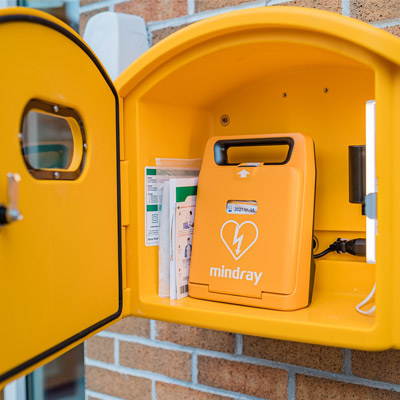

London Hearts and the Mindray BeneHeart C1A AED have been selected as the supplier and defibrillator of choice by the Department of Health & Social Care (DHSC) for its new £1 million Community Automated External Defibrillators (AEDs) Fund.
The fund aims to make more AEDs available in public places to improve the survival rates for out-of-hospital cardiac arrests. Every minute that a person in sudden cardiac arrest does not receive defibrillation, their chances of survival drop by 7-10%.
Following a competitive tender process, London Hearts in partnership with Smarter Society secured the contract to supply AEDs and administer the fund. The Mindray Beneheart C1A AED has been selected as the premier AED for the roll out. London Hearts will also contribute towards match funding for eligible applications alongside the DHSC.
The advanced clinical specification of Mindray’s BeneHeart C1A AED made it a stand-out solution:
- Rapid charge time means the first shock can be delivered in less than 8 seconds.
- Step-by-step animated and vocal guides for rescuers automatically tailor instructions to suit rescuer proficiency.
- 360J biphasic technology automatically adjusts shocks based on patient impedance to help treat difficult to defibrillate patients
- Defibrillation therapy is provided according to AHA/ERC guidelines; delivering 200J initially, then 300J for the second shock and 360J for the third.
The Community AED Fund will support distribution of 2,000 AEDs across England. 100 AEDs will be fully funded in areas with the greatest need for defibrillators. Other applications will receive a match funding contribution from DHSC and London Hearts.
Community groups and social enterprises such as sports clubs, social clubs and places of worship are eligible for funding.
Every recipient organisation will receive training so individuals feel more confident using the AED and can increase their chances of saving lives.
Paul Bailey, General Manager of Mindray UK said, “This new community fund will help save so many lives and Mindray is extremely proud to supply the AEDs. We look forward to continuing our successful partnership with our distributor, London Hearts, with whom we have already successfully installed thousands of public access AEDs across the UK.”
Jo Lovell, Operations Manager at London Hearts said, “We are incredibly proud to have been chosen to work with the Department for Health and Social Care (DHSC). At London Hearts we see first-hand the amazing fundraising efforts of individuals, community groups and social enterprises who want to install life-saving AEDs. This funding scheme will be a huge boost towards achieving their goals and improving survival rates from cardiac arrest.”
To find out more about Mindray’s BeneHeart C1A AED visit; www.mindray.com/uk/products/aed/beneheart-c-series
Find out more about the eligibility criteria and how to apply for the Community AED Fund at: www.defibgrant.co.uk
For further information visit: www.mindrayuk.com
- Details


Innovative medical equipment manufacturer Mindray has introduced next-generation BeneHeart series defibrillators, the BeneHeart D60 and D30, to the UK. The new device aims to raise the standards for resuscitation and defibrillation, providing fast diagnosis in emergency rescue situations.
According to the Resuscitation Council UK, the annual incidence of in-hospital cardiac arrest is 1 to 1.5 per 1,000 hospital admissions. There are also more than 30,000 out-of-hospital cardiac arrest incidents every year with a survival rate of less than 1 in 10.1 Early CPR and defibrillation can more than double the chances of survival in some cases. This makes the combination of highly trained medical staff and efficient, effective equipment crucial, especially for identifying hidden trauma and informing hot debriefings when a patient isn’t responding to CPR.
NHS standard contracts state that patients arriving at an emergency department by ambulance must be handed over to the care of A&E staff within 15 minutes2. This, added to the already intense pressure on the provision of potentially life-saving care, means A&E staff need 100% confidence in the tools at their disposal.
“Defibrillators play a critical role in reducing all-cause mortality and emergencies. We believe that through upgrading first-aid diagnosis and treatment tools and introducing comprehensive rescue quality improvement schemes, prompt, correct, and high-quality medical interventions can save patients’ lives and improve their quality of life,” comments Paul Bailey, General Manager, Mindray UK.
 The BeneHeart defibrillators are designed to provide emergency rescuers with more comprehensive information on the scene. This live patient data is then shared with emergency departments and hospitals via digital workflows so clinical teams can prepare for arrivals and provide the best possible care. In essence a complete quality improvement solution for both pre-hospital and in-hospital rescue allowing advanced treatment planning that can save lives.
The Mindray BeneHeart D60 has multiple diagnosis and analysis functions so rescuers have a more holistic picture on patient status even in complex pre-hospital environments. Professional 12-lead ECG analysis functions with intelligent assistance help to efficiently diagnose chest pain conditions and identify myocardial infarction locations, whilst a 6-channel recorder generates real-time ECG reports.
The D60 is the first defibrillator of its kind to incorporate point-of-care ultrasound for accurate and confident decision-making by providing step-by-step identification tools, operation guides, and reference images. This latest technology guides the user through ultrasound to ensure H’s and T’s during cardiac arrest are ruled out.
The D30 and D60 are the first defibrillator to incorporate patented non-invasive CQI (care quality index) technology that illustrates blood blow in cardiac arrest. Resuscitation Teams can now accurately comment of efficiency of chest compressions and ROSC (return of spontaneous circulation) without the needed for invasive technologies.
There are several upgrades to note on both units that improve ease of use and reliability. The high-definition capacitive touch screen allows for increased operational efficiency, whilst actual dials and buttons can be used for critical procedures. Weighing only 4.2kg with battery, the defibrillators are water and dust-proof and incorporate a drop-protection design with the ability to operate in temperatures ranging from -20°C to 55°C.
 Equipped with patented QShockTM technology, the units have a turn on time of just two seconds and charge to 200 joules in three seconds with an ability to escalate to 360 joules. This, along with filtered ECG analysis technologies, provides faster defibrillation and a comprehensive CPR evaluation system to monitor real-time CPR performance, with instant feedback for clinicians.
The new BeneHeart defibrillators empower structured debriefing that support automatic rescue data recording for hot debriefing. The capabilities for connectivity help resuscitation teams improve CPR and defibrillator operation through audit and cold debriefing.
The technologies and features of these new defibrillators incorporate Mindray’s ‘Rescue Triangle’ concept where all-round resuscitation covers the whole clinical process from resuscitation to debriefing and training.
Fast diagnosis in all emergency situations will bring increased resuscitation rates. Reliable, trusted, smart technology is the answer.
Mindray is a leading global developer of medical devices, with an R&D network spanning the US, Europe, and China. With a local focus on patient monitoring and ultrasound in the UK, Mindray provides innovative medical devices to a range of hospital departments, including emergency, perioperative and critical care.
For further information visit: www.mindrayuk.com
Sources:
- Details
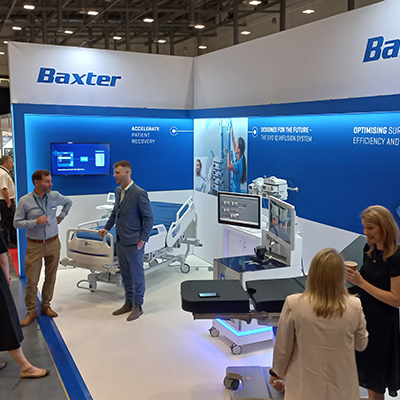
The largest, most attended, EBME Expo took place on 28th-29th June 2023 attracting many clinical engineers and other healthcare professionals, discussing key issues relating to healthcare technology, operating theatres, training and procurement planning. The EBME Expo 2023 was held at the Coventry Building Society Arena. This year we had additional conferences and workshops for the delegates. The 46 speakers across all 3 conference areas were very well received by the delegates, and a considerable amount of knowledge and innovation was shared.
There were many positive comments from the delegates about the new audio systems we introduced, which used wireless headphones, instead of floor standing speakers. The headphones were used across all the conference areas, enabling the delegates to focus on the speakers, without hearing the background ‘hustle bustle’ of the exhibition stands which could otherwise be distracting. Also, not having the drapes really opened up the space, and allowed the exhibitors and visitors who were not in the conference areas to see the stages, and who was on each stage.
The conference programmes offered a valuable insight into how we buy, use, maintain and manage healthcare technology – in operating theatres, diagnostic centres, at the hospital bedside, in virtual wards, and in war zones. The speakers engaged with key issues around training, human factors, new technologies (including AI), cyber security and the associated threats with networked medical device technologies. One speaker, Iryna Rybinkina gave a particularly moving presentation discussing the issues of mobilising ambulances, and emergency medical technology in war-torn Ukraine. Iryna returned home to Ukraine and set up the ‘Smart Medical Aid Charity’, which raises funds and procures medical equipment and supplies for the war effort in Ukraine and also provides medical and paramedical training for the medics working on the frontline.

Mark Fordham (left), a medical engineering trainer from Eastwood Park, explained the important role of clinical engineers during his presentation on defibrillator waveforms.
A continuous theme coming from many of the speakers was the importance of AI. The speakers explained that Artificial intelligence (AI) has the potential to revolutionize the field of medical diagnosis.
Some of the discussions centred around general applications:
Accuracy: AI algorithms can be trained on large datasets of medical images and other data, which can help them to identify diseases more accurately than human doctors. For example, one study found that an AI algorithm was able to detect diabetic retinopathy with 94% accuracy, compared to 86% accuracy for human doctors.
Speed: AI algorithms can analyze large amounts of data much faster than human doctors. This can help to speed up the diagnostic process, which can be especially important in cases of life-threatening diseases.
Efficiency: AI algorithms can automate many of the tasks involved in medical diagnosis, such as image analysis and data interpretation. This can free up human doctors to focus on other tasks, such as providing patient care.
Accessibility: AI algorithms can be used in remote areas where there are few qualified doctors. This can help to improve access to quality medical care for people in these areas.
In operating theatres, AI can:
Guide surgeons during surgery - AI-powered surgical robots can provide surgeons with real-time guidance and assistance during surgery. This can help to improve accuracy, precision, and safety.
Detect and prevent complications - AI can be used to monitor patients during surgery and detect potential complications early. This can help to prevent serious problems and improve patient outcomes.
Optimize surgical workflows - AI can be used to optimize surgical workflows and reduce the risk of errors. For example, AI can be used to automate tasks such as setting up equipment and preparing instruments.
In addition to these benefits, AI is also being used to develop new diagnostic tools and treatments. For example, AI is being used to develop new drugs and to identify new biomarkers for diseases. Overall, AI has the potential to make a significant impact on the field of medical diagnosis. By improving accuracy, speed, efficiency, and accessibility, AI can help to save lives and improve the quality of care for patients.

I must finally thank all the exhibitors who displayed the latest technologies, services, training solutions, and delivered incredible educational workshops for the delegates. The drinks reception was also a new addition – Thank you to MTS Health Ltd for sponsoring this in honour of Paul Austin, and the new ‘Apprentice of the year award’. It was lovely to relax at the end day 1, and socialise with so many wonderful colleagues who decided to stay for the reception.
I was pleased to be able to meet so many of the exhibitors who all expressed their thanks for developing the EBME Expo into what it is today, but we couldn’t have done that without the organisers, AV teams, build teams, and Coventry Arena Staff. A big thank you goes to BtoB Events, who work meticulously to ensure this event goes ahead without a hitch.
The exhibition space is already 85% sold for 2024, with many new and exciting companies coming along to show us their latest technology. I look forward to seeing you all at the EBME Expo 2024 on Wednesday 26th and Thursday 27th June. Don’t forget to put these dates in your diary!
Dr John Sandham
Chairman.
